



On Monday we talked about how character’s are the story. Today, I pose another idea: while characters may be the story, what really makes your story interesting is the antagonist. And in the case of most thrillers, the antagonist happens to be a villain.
If you’re wondering about the distinction between villains and antagonists, check out this other post where I address this very question. Essentially, what you need to know is that antagonists are any obstacles that get in the way of the hero’s goal, while the villain is a specific character who personally interferes with that goal. All villains are antagonists, but not all antagonists are villains.
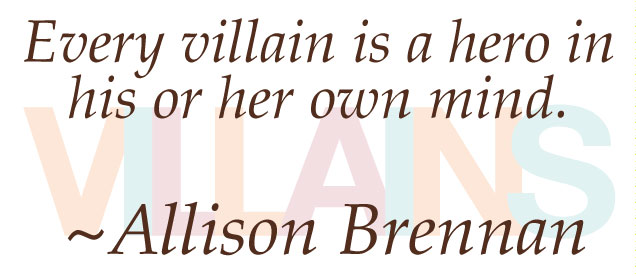
During Thrillerfest, I attended an excellent talk by author Allison Brennan, who emphasized the importance of having a compelling villain as well as a sympathetic hero character. Brennan talked about how it’s important for the reader to understand the villain’s endgame and the motivation behind what he or she is doing. The reader needs to want that the villain almost gets away with it (but not quite). This means that the villain must believe his or her cause is justified.
How does this play out in story-telling? The writer’s job is to make the villain not be 100% evil and this means the villain must have a reason for doing what he or she does. Here are a couple of ways to enhance the traditional good vs. evil model of heroes and villains.
Make the hero and the villain want the same thing.
Sometimes the hero and the villains actually want the same thing. Vigilante villains are fascinating and it’s easy for readers to relate to a villain whose motivation is to kill the “real” bad guys. If the hero wants the criminals brought to justice and the villain is out to kill these criminals, then really, the hero and villain are on the same side, they just have different approaches. This hero-villain dynamic also forces the hero to question his or her own motivations and beliefs, which makes for a more interesting story.
Make your hero a less-than-super hero.
Everyone has a fatal flaw. Even superheroes have a fatal flaw: they always have to do the right thing. Traditional heroes on the other hand don’t always have to do the right thing, but they are constrained by rules of law or moral boundaries. The key here is to push your hero to see how far he or she will go to stand for a cause. Villains, on the other hand, do not need to abide by rules of law or moral boundaries, they can stop at nothing until they reach their goals. To heat up your story, use your villain to push your hero almost to that point of no return.
Give the villain a pet-the-dog moment.
The pet-the-dog moment is a term used in film making where the hero is about to fight the bad guys in a dark alley. He hears a rustle and turns to find a stray dog. The hero pets the dog and says: “Better get outta here, little fella. There’s gonna be trouble.” The dog scampers off. That’s the classic pet-the-dog moment and it’s usually used to give tough-guy heroes a little bit of a soft spot. Note: Pet-the-dog moment don’t always have to involve dogs. They can involve any number of cute fluffy animals or adorable small children. (For instance, that movie Kindergarten Cop is basically one long film-length pet-the-dog moment. There’s a classroom full of cute kids, plus a ferret. Need I say more?)
How do the pet-the-dog moment this relate to your villain? Ever notice how the evil bad guy is often found petting a cat, usually with a saccharine name like “fluffy”? That’s a pet-the-dog moment and the point is to give the villain a soft spot. Brennan gave a fabulous example of how this works. In Silence of the Lambs, Buffalo Bill has a pet toy poodle named Precious. It’s an annoying little yappy dog, but he constantly coos over it. That dog is ultimately his undoing because while he’s able to do horrific things to his victims, when one of his victims lures the dog and threatens to kill it, Buffalo Bill can’t bear to lose his Precious. That’s the pet-the-dog moment at work right there.
Give your villain an “all is lost” moment in the story.
For the hero, the “all is lost” moment is when it appears everything is over and the good guys have lost. This moment in the plot is often dubbed the hero’s “dark night of the soul” because it’s when the hero has to do some serious soul-searching and figure out whether or not to go on. But the villain also needs an “all is lost” moment, though in the villain’s case it’s more like a “ray of hope for the soul” where we feel like maybe the villain might actually do the right thing. This goes hand in hand with the pet-the-dog element because the point of the “all is lost” moment is to show that the villain is not all bad, that there is a glimmer of humanity buried inside that monster.
While your villain might not change completely in the story, giving him or her that “ray of hope” moment adds depth to the character. Perhaps the villain has doubts about what he or she is doing. Perhaps he or she regrets what has been done. The difference between the villain’s doubts and regrets and those of the hero is that hero must change throughout the story, but the villain can always go back to his or her evil ways.
Make your hero and your villain into rivals.
This is the flip side of the villain and the hero wanting the same thing. In this case, your villain wants the exact opposite of what your hero wants. Remember how your villain will stop at nothing, but your hero must be bound by rules of law or morality? That definitely comes into play when the hero and villain are direct rivals because the villain is automatically at an advantage. The villain is usually a little bit smarter and a lot more ruthless than the hero. Since your villain does not play by the rules but your hero must do so, this means your hero needs to work twice as hard in order to win the day.
(talking about rivals)
Ultimately, these techniques are just variations on a theme. You need to figure out what works best for your story. So sit down, write, and make those characters so real they jump off the page. In the words of Allison Brennan:


