



We’re back with another three-act analysis. This time around, I wanted to see if the three-act structure would hold up with a story from the Marvel Comics Universe (MCU), namely the first Captain America film. As it turns out, this movie fits the framework to a T, serving as yet another example of how versatile the three-act structure is.
Spoiler Alert! This film was released in 2011, meaning that it’s been around for a while. In fact, a lot has happened in the MCU since the Captain first came on the scene. Obviously, it’s impossible to talk about a movie’s structure without giving away the ending, and this example is no different. There will be spoilers.
Okay, let’s dive into our analysis of Captain America: The First Avenger.
PROLOGUE: The story begins with a prologue of sorts. Scientists discover a wreckage buried in ice and call in the military. As they explore the inside of the strange vehicle, they come across Captain America’s shield.
Next, we flash back to 1942 Norway, where an old man is hiding in an ancient stone church protecting something. Uniformed officers from Hydra burst in with a tank, knocking down a wall. They are looking for the mysterious thing the old man is protecting (the Tesseract). Johann Schmidt, the head of Hydra, finds the Tesseract hidden behind a secret panel in the wall, and takes it. The old man warns him that he cannot control the Tesseract’s power, but Schmidt kills him.
ACT 1: In New York, Steve Rogers is rejected from enlisting because of his small stature and many health problems. He wants to be recruited and serve in the war like his father did. (His dad served and died in World War I.) He is so desperate to be recruited that he has tried multiple times and has even lied on his recruitment forms.
Rogers and his best friend Bucky go to the World Exposition of Tomorrow the night before Bucky leaves for Europe. Bucky tries to set Rogers up with a girl so they can double-date but Rogers isn’t interested. He’s holding out for the right girl. He wanders away from the group and goes to another recruitment office. At the recruitment office, Dr. Abraham Erskine of the Strategic Scientific Reserve allows Rogers to enlist in a special program.
FIVE PROMISES: The five promises of act 1 get answered early in the story.
Character: Steve Rogers is our protagonist. He is physically small and weak, but he desperately wants to fight in the War.
Voice: As with most movies, there isn’t a voice per se but a mood. In this case, even while some parts of the film can be dark, the mood is largely optimistic.
World: The bulk of the story takes place in 1942-1943, during World War II. While the story is set in the past, a lot of the Hydra technology feels futuristic.
Problem: Rogers wants to fit in the war, but he keeps getting rejected because of his health and small stature.
Event: The day before his best friend leaves for the War, Rogers finally gets recruited for a special, secret program.
ACT 1 (Cont’d): Meanwhile, in the mountains, Dr. Zola and Schmidt try to harness the power of the Tesseract. They are able to stabilize it and realize they can use it to power Hydra technology, changing the course of the war.
Back in the US, Rogers is in training and meets Agent Peggy Carter and Colonel Phillips. Rogers fails most of the physical challenges of training, but shows intelligence and strength of character. Eventually, Col. Phillips is convinced that he should be the one selected for the procedure to become a super soldier.
The night before Rogers is going to have his procedure, Dr. Erskine visits him in the barracks. Rogers asks why he was chosen and Dr. Erskine says: “Because a strong man, who has known power all his life, will lose respect for that power. But a weak man knows the value of strength and knows compassion.” Erskine also tells Rogers about Schmidt, the first man to take the serum, and how that serum amplified his evil qualities.
The next day, Rogers is taken to a secret lab where Dr. Erskine and tech genius Howard Stark have rigged a machine to give him serum and turn him into a super soldier. At first it seems Rogers can’t tolerate the procedure and they almost shut it down, but then he protests so they continue. When the machine opens, Rogers has transformed from a scrawny, weak guy into a superhero.
RULE OF 3: Rogers gets tested three times before he receives the serum, and all three times he shows strength of character despite his weak body. The first test is when he meets Dr. Erskine, who asks him if he wants to kill Nazis. Rogers replies that he doesn’t want to kill anyone, but he hates a bully. This answer shows Rogers’ principles and his motivation to protect others.
The second test occurs when he is in training. He and the other recruits are running past a flagpole and the drill sergeant challenges them to climb it and get the flag. All the other men try and fail. Rogers then loosens a pin at the base of the pole and it falls down, allowing him to get the flag easily. This moment demonstrates Rogers’ intelligence and his ability to see past the obvious answers.
The last test happens when Rogers and the other recruits are at back the camp doing calisthenics. Col. Phillips takes a grenade, pulls the pin and throws it at the men. Everyone ducks and hides except for Rogers, who throws himself on top of it. This action proves that Rogers will do anything—even sacrifice himself—to protect others. This is the moment that convinces Col. Phillips that Rogers is the best candidate to receive the serum.
PIVOT POINT 1: Just after Rogers has his transformation, a man posing as a government official sets off a bomb and shoots Dr. Erskine. He grabs the one remaining vial of serum and runs. Dr. Erskine dies, and Rogers goes after the man. The external event at this pivot point is the bomb going off. The internal choice is Rogers’ decision to pursue the man.
A chase through the streets of New York ensues, and they end up at the docks. The man tries to escape via a Hydra submarine, but Rogers swims after and catches him. When Rogers throws the man up on the docks, that last vial of serum breaks and the man swallows a poison pill. He dies saying “Hail Hydra.”
ACT 2: Meanwhile, back at the mountains, some of Schmidt’s superiors come to his secret base and criticize his work. It turns out that Schmidt has been planning a mutiny all along, and he kills them all.
After the chase with the Hydra operative, the US government assigns Rogers to help raise money for the war effort. Dressed as Captain America, he performs to packed theaters and also on screen. The show involves a lot of dancing girls and the Captain punching a guy dressed as Hitler. The civilians find his show entertaining.
Eventually, Rogers ends up performing to boost morale at an army camp a few miles from the front in Italy (1943). The soldiers are not interested in his show and throw tomatoes at him. Agent Carter stops by the camp and tells him after the show: “You were meant for more than this.” She tells him that these men have seen it worse than most in the war and that the majority of their unit has been killed or captured. Rogers learns that this is the same unit his best friend Bucky joined. He thinks Bucky may have been captured.
Col. Phillips refuses to plan a rescue mission, so Rogers decides to do it himself. With the help of Agent Carter and Howard Stark, he parachutes into enemy territory and takes on the whole Hydra base on his own. He releases the prisoners being held captive, but Bucky is not among them. As the rest of the men fight their way out, Rogers looks for Bucky. Dr. Zola and Schmidt are in the facility and they set off a self-destruct sequence. Just after Rogers finds Bucky, they run into Dr. Zola and Schmidt. Rogers and Schmidt fight briefly and then Schmidt pulls off his mask, revealing that he is Red Skull. Dr. Zola and Schmidt get away but Rogers and Bucky are cornered. Bucky is able to cross to safety via a wobbly beam, but the beam collapses and Rogers has to use his super soldier strength to jump.
Back at the camp, Col. Phillips and Agent Carter believe Rogers has been killed in action. At that moment, Rogers leads the freed prisoners into the camp, and everybody cheers for Captain America.
MIDPOINT: The rescue mission involves two temporary triumphs with the moment of self-reflection sandwiched in between. The first temporary triumph is when Rogers frees the prisoners and then finds Bucky. It feels like a triumph because it seems that Rogers has succeeded at his mission.
The self-reflection is implied during the scene where Rogers confronts Schmidt (who has now fully stepped into his Red Skull persona). The latter says: “You are afraid to admit that we have left humanity behind. Unlike you, I embrace it proudly, without fear.” The implication is that, because of their extraordinary abilities, he and Rogers are superior beings and the future of humankind.
Like with most movies, we do not have a true moment of introspection because we can only know what Rogers is thinking based on his dialogue, actions, and body language. That said, Red Skull’s words suggest that he is what Rogers could turn into if he allows his power to corrupt him.
The second temporary triumph is when Rogers arrives back at the camp, leading the prisoners. He offers to turn himself in for disciplinary action, showing his continued humility, but Col. Phillips lets him off the hook.
ACT 2 (Cont’d): While rescuing the prisoners, Rogers caught a glimpse of a map showing the various Hydra weapon factories. Co. Phillips puts Rogers in charge of destroying all the Hydra factories. Rogers assembles a team including several of the prisoners he rescued and his friend Bucky. Howard Stark gives his shield an upgrade.
With his team, Rogers starts taking down each of the Hydra facilities one by one. As Agent Carter and Col. Phillips watch video footage of their attacks, we see that Rogers carries a compass with a photo of Agent Carter tucked inside.
Rogers and his team plan to sabotage a Hydra train because they have intel that Dr. Zola is on it. It turns out to be a trap, and it seems like Rogers and his team are outmatched. Bucky falls from the train and into the ravine below. The team eventually takes the train and captures Dr. Zola.
PIVOT POINT 2: Rogers tries to drown his sorrows, but because of his superhuman abilities, he can’t get drunk. He blames himself for Bucky’s death, and Agent Carter tries to convince him that it’s not his fault. Rogers says he’s going after Schmidt and won’t stop until all of Hydra is dead or captured. The external event for this pivot point is Bucky’s death, and the internal choice is Rogers’ decision to go after Schmidt.
ACT 3: Schmidt’s secret base is in the Alps. He plans to cross the Atlantic in a giant, futuristic plane, using his Tesseract-powered weapons to attack the United States. Rogers and his team make a plan to storm the Hydra base.
CRISIS: Rogers rides into the base alone on his motorcycle and for a minute it looks like he might be able to take on all the Hydra troops himself, but he is eventually outnumbered and is taken prisoner to Schmidt. While Rogers confronts Schmidt, the rest of his team storms in, which had been the plan all along.
Schmidt runs off, and Rogers goes after him while his team takes the base. Grabbing the Tesseract, Schmidt boards his spaceship-like plane and sets a course for New York. Rogers runs after the plane but can’t catch up until Col. Phillips and Agent Carter pull up in Schmidt’s fancy car. They drive Rogers right up to the plane, and before he leaps aboard, Agent Carter kisses him. The plane takes off with Rogers, Schmidt, and a few Hydra troops aboard. Rogers fights some of the Hydra troops and destroys a few smaller attack planes, then goes to the main control room.
CLIMAX: Rogers finds Schmidt in the control room, and they fight. During the altercation, he throws his shield at the Tesseract apparatus and breaks it. Schmidt picks up the Tesseract with his bare hand, and it slowly disintegrates him. He is destroyed by his own hubris.
Ending Type: Rogers starts out wanting to stop the global bullies (Nazis and later Hydra). He ends up destroying Red Skull (Schmidt) and thwarting Hydra’s attempt to take over the world. In other words, at the end of the film, Rogers gets what he wants, and he still wants that thing, so it is a happy ending.
DENOUEMENT: After Schmidt is destroyed, Rogers gets into the pilot’s chair. He radios his team, and they want to help him bring the plane down safely, but it’s going too fast. Rogers realizes he has to bring it down before it reaches a more populated area. He tells Agent Carter what he’s going to do. She tries to convince him otherwise, but he’s determined. They say some tearful last words as he brings the plane down into the ice and the radio goes silent. As the ice breaks, the wreckage of the plane gets buried.
The Allies win the war. His team drinks to Rogers’ memory. Later, Stark is on a ship searching for Rogers and the wrecked plane. He and his team find the Tesseract at the bottom of the ocean, but there is no sign of the wreckage or Rogers.
Suddenly, Rogers wakes up in a hospital. It looks like he’s in the 1940s, but it’s all a ruse. He figures out that the hospital is fake, so he breaks out and runs into present-day Times Square in New York. Several secret agents go after him, and he’s cornered. Nick Fury steps forward and tells him the truth: that he has been asleep for almost seventy years. The movie ends, leaving room for all the rest of the Avengers series.
CONCLUSION: Captain America: The First Avenger is a great example of a story in which the protagonist shifts archetypes not once but twice. At DIY MFA, we believe there are four main character archetypes: underdog, disruptor, survivor, and protector. These archetypes come from looking at the character’s type (relatable vs. aspirational) and what they want (either to change or preserve). When we consider both parameters simultaneously, we get the following matrix:
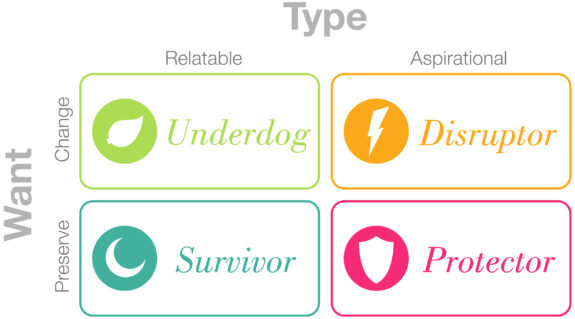
In other words, the underdog is a relatable character who wants to change something in themselves, their circumstances, or the world, while the disruptor is an aspirational character who seeks change. The survivor is a relatable character wanting to preserve something in themselves, their circumstances, or the world, while the protector is their larger-than-life counterpart.
Rogers starts out as an underdog. He’s just a regular guy from Brooklyn who wants to do his part and serve in the War. While he is relatable, he shows hints of greatness in the tests that create the rule of three. We realize that while he is not physically strong, there is more to him than we might at first assume.
When he rescues the troops being held in the Hydra prison, Rogers goes from underdog to disruptor, shifting his character type from relatable to aspirational. He continues as a disruptor throughout the time he is taking down the Hydra factories. In fact, he stays in disruptor mode until after Bucky’s death, when he decides to get revenge on Schmidt and Hydra. At that point, he becomes a protector archetype.
Revenge is a preserve-driven desire because it stems from the feeling that something bad has happened and justice must be served. Bringing the bad guys to justice and restoring a sense of order are goals with preservation at their core. After destroying Red Skull, Rogers cements his role as a protector by sacrificing himself and crashing the plane into the ice.
As with most character shifts we see in books and movies, Rogers does not jump directly from underdog to protector, but instead makes lateral moves. This is crucial because a diagonal leap across the archetype matrix means the audience must make two cognitive shifts at the same time. By making lateral moves from underdog to disruptor followed by disruptor to protector, the character evolves more naturally.
A jump across the diagonal could potentially feel unrealistic to the audience, making the protagonist seem like they are behaving out of character. This film is a perfect example of a protagonist who shifts across the diagonal, but does so in a natural, step-by-step manner.
Until next time, keep writing and keep being awesome!

P.S. For more info on Gabriela Pereira, the founder and instigator of DIY MFA, check out her profile page.


