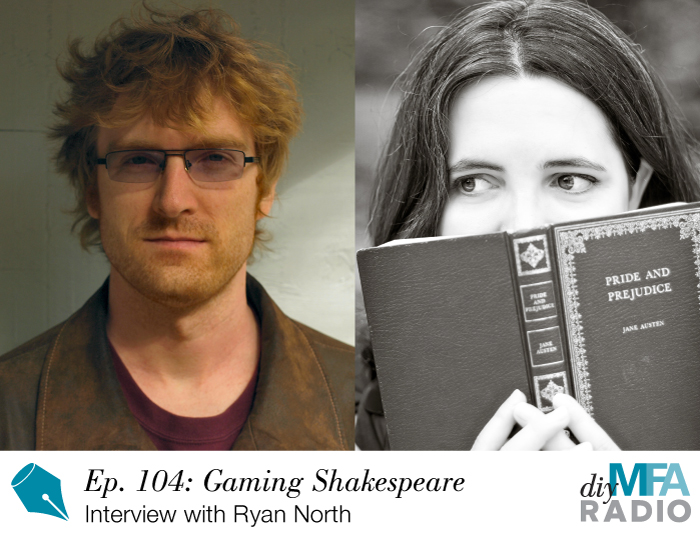
Featured Image: Ryan North

Episode 104: Gaming Shakespeare – Interview with Ryan North

Hey there Word Nerds! Thanks for joining me for today’s awesome DIY MFA Radio interview with author Ryan North. When one of my contacts over at Penguin told me Romeo and/or Juliet and asked if I wanted to bring the author on the show, my immediate reaction: “Shakespeare meets choose-your-own adventure? Yes please!” The fact… Read more »

How To Use Story Archetypes To Subvert Expectations

A few weeks ago while I browsed through the YA aisle in Barnes and Noble, I flipped through the Q&A section in the back of one of Lauren Oliver’s books. One of the things Oliver cited as inspiration for her popular Delirium trilogy was something she’d read that said all stories are either about love… Read more »

Three Steps to an Outline That Works for You

In a blog post dated April 2013, about a month before his New York Times bestseller The Fifth Wave hit shelves, Rick Yancey listed four reasons not to be a writer. His second was “Failure is guaranteed.” Here’s what he had to say: “You have to come to terms with your own loser-ness. I do this by looking at… Read more »

How Structure Can Loosen You Up

Structure. Constraints. Boundaries. Are you already withering up a little and looking for an escape? The idea of being fenced in by rules and structure can feel stifling, but it shouldn’t. Adding structure can actually be freeing. In one famous experiment, preschool children were observed playing at a playground without a fence around it, and later… Read more »

Untraditional Outline Techniques

This past week we’ve been talking about outlines.  On Monday I asked the question: Plotter or Pantser? Where Do You Stand?  That post got me thinking about my own writing process. I’m usually not a seat-of-my-pants writer but I hate traditional outlines.  Something about long lists (I.A, 2.b–it’s all Greek to me) just doesn’t work… Read more »

How to Create a Story Map

One of my favorite ways to outline or plan a story is to map it out like a subway or road map.  Here’s how this technique works. Each road or subway line represents a different story-thread or plot line.  The dots (exits on the highways or subway stops) represent different scenes or moments in the… Read more »

Villains vs. Antagonists

Every story needs a “bad guy,” someone or something that gets in the protagonist’s way and keeps making trouble for him or her.  For instance if my life were a novel, the “bad guy” would be an impossibly cute 3-year-old ginger cat, whose offenses include: “Decorating” the living room with shredded articles of mail Skulking… Read more »